



Will AI Make Humans Obsolete—or Finally Free?
11th Mar 2026 | Author - Viraj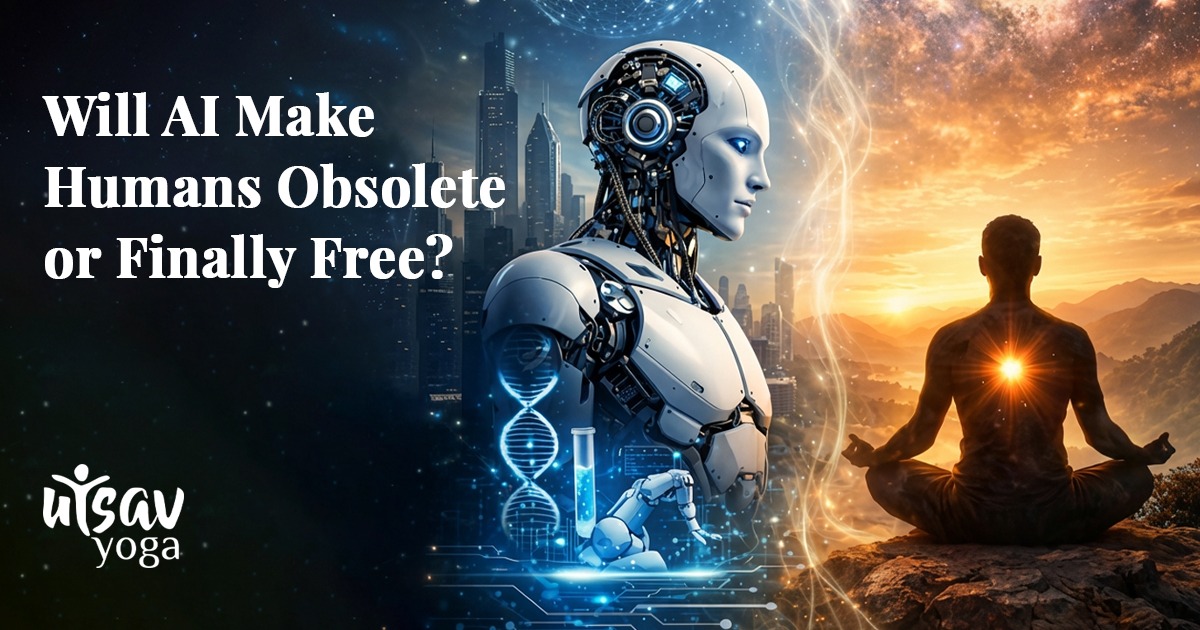
Artificial Intelligence and robotics today stand at a historic inflection point. For the first time in human history, we are witnessing
machines that are not merely tools but systems capable of learning, communicating, researching, creating, and even improving
themselves.
Until now, every machine humanity built had limited capabilities. A tractor could plough fields. A computer could calculate. A factory
robot could assemble parts. But these machines were confined to narrow tasks designed by humans.
What is emerging today is fundamentally different.
We are beginning to see machines that can absorb the accumulated knowledge of humanity and apply it instantly across domains. AI
systems already assist in legal advice, medical consultation, software development, research, education, entertainment, and even
drug discovery. With the rapid fusion of artificial intelligence and robotics, the next decade may see the rise of humanoid robots
capable of performing both physical and intellectual tasks.
For the first time, humanity may witness machines that rival human beings not just in physical labour, but also in knowledge and
cognitive capabilities.
The pace of development is extraordinary. Entire industries are being transformed, and the economic and social implications remain
deeply uncertain. One thing, however, appears increasingly clear: a vast portion of the mundane work that occupies human life today—
both manual and knowledge-based—may gradually be taken over by machines.
If that happens, humanity could enter an era of unprecedented productivity and abundance.
But this raises a profound question.
What happens to human beings when both the body and the mind are no longer required for survival?
For thousands of years, human civilization has been shaped by challenge. We built societies by solving problems—finding food, building
shelter, defending communities, inventing tools, developing science, and expanding knowledge.
Life often felt meaningful because it demanded effort.
But in a future where machines perform most tasks more efficiently than humans, the traditional drivers of meaning—work, effort,
competition, and productivity—may no longer define our existence.
Human beings may suddenly find themselves with something they have rarely had in abundance:
Time.
A great deal of time.
Material comfort may increase dramatically. Lifespans may extend. Many physical and intellectual challenges may be handled
by intelligent systems.
Yet a deeper question emerges.
Will humanity thrive in such a world, or lose its sense of purpose?
When the body and mind are no longer essential instruments of survival, human beings may face a very different challenge:
learning how to live with themselves.
Some people may gravitate toward endless consumption—seeking pleasure, stimulation, and entertainment in a world
where technology provides infinite options.
But others may feel a different pull. When external struggles diminish, attention naturally turns inward.
Questions that once felt philosophical may become deeply personal:
Who am I beyond my work?
What is the purpose of life?
What truly distinguishes human beings from the intelligent machines they create?
It is quite possible that the systems we build will eventually surpass us in many measurable capabilities. A sufficiently advanced AI could
combine the knowledge of billions of people into a single system. It could process information faster, analyze problems more efficiently,
and generate solutions beyond human capacity.
But there is one dimension where machines may still remain fundamentally different.
Human beings have the ability to experience awareness itself.
The essence of humanity may not lie merely in intelligence, productivity, or creativity. Those abilities can increasingly be replicated or
amplified by machines.
The deeper distinction may lie in consciousness.
Human beings possess the capacity to step back from their thoughts, observe their emotions, and inquire into the nature of their own
existence. They can question reality itself.
In that sense, humans have the unique ability to break the matrix of conditioned experience.
This is where ancient traditions like yoga become deeply relevant in a technological age.
Yoga is often misunderstood as a physical practice or a wellness routine. But in its deeper sense, yoga is a science of self-inquiry. It is a
method to understand the distinction between the observer and the observed, between subject and object.
Through sustained practice, yoga allows a person to examine the structures of the mind and ultimately discover a deeper nature of
reality.
In a future where machines take over most external challenges, the greatest frontier may not lie outside us—but within us.
If artificial intelligence liberates humanity from many material struggles, it may also open the door to the oldest inquiry known to human
civilization:
Who are we, really?
Perhaps the age of intelligent machines will not diminish humanity after all. Instead, it may push us toward discovering the one
dimension machines cannot replicate—the direct experience of awareness and the exploration of consciousness itself.
In that sense, the rise of AI may not mark the end of human purpose.
It may simply shift the focus of human evolution—from conquering the external world to understanding the inner one.