



Why Are We So Scared to Fall in Love? Understanding Fear, Vulnerability & Love
12th Nov 2026 | Author - Viraj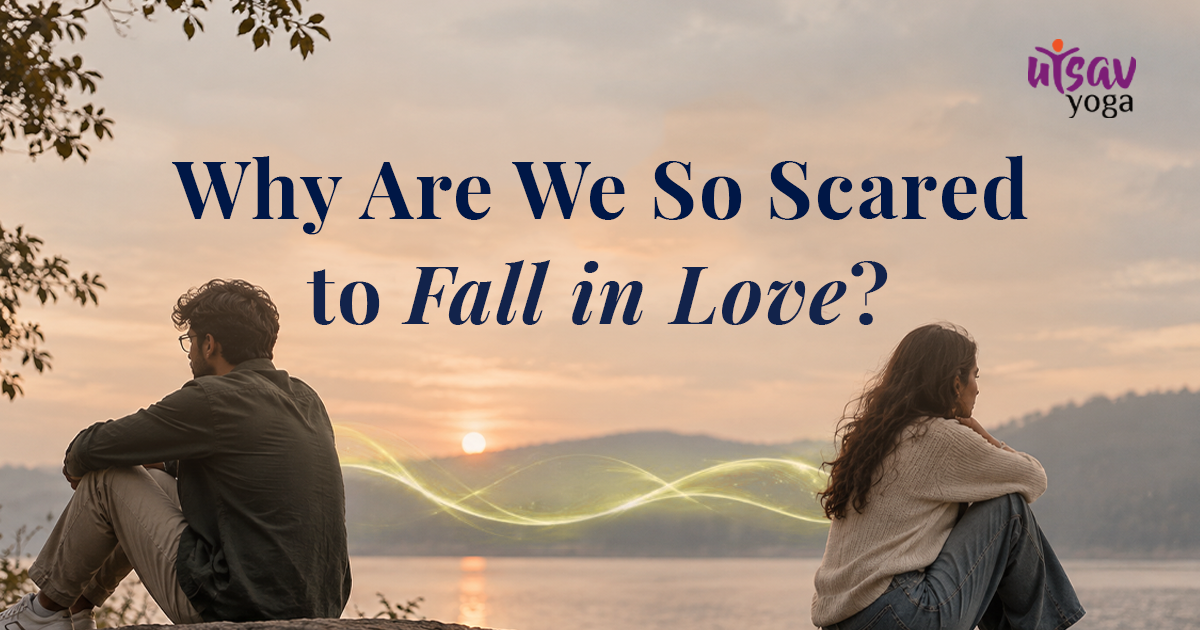
Why Are We So Scared to Fall in Love?
Perhaps our fear of falling in love has less to do with love itself and more to do with our fear of getting hurt, losing control, and becoming vulnerable. But what if love—including its pain and uncertainty—is one of life’s greatest teachers?
Why Are We So Afraid to Love?
Why is a human being so scared to love? Why are we so scared to fall in love?
Is it because we have fallen in love before and tasted the ground? Or because we have fallen so deeply in love that we have never quite been able to come back again?
Or is it because of the social pressures and conditioning that have always, in some way, preached caution against love?
Think about it. We all want to be loved. We crave companionship, intimacy, and connection. We want someone who understands us, accepts us, and makes us feel special.
Yet, when it comes to opening ourselves up to love, we often hold back.
We are scared of rejection, heartbreak, betrayal, and, perhaps most importantly, vulnerability. We are afraid of becoming attached, only to lose the person someday.
We have become so conscious of protecting ourselves that sometimes we don't even allow ourselves to experience love fully.
But perhaps we are looking at love the wrong way.
What If Love Is More Than Finding Someone?
What if love is not just about finding someone?
What if love is actually an experience that flows through us?
When we fall in love, something changes within us. We become more alive, more sensitive, and perhaps even more compassionate. We start looking beyond ourselves. We experience emotions that we may never have experienced before.
The world suddenly seems a little more beautiful.
There is a certain flow of energy that comes with love. And like any other energy, it needs to flow. When we try to control it, possess it, or restrict it to our expectations, we perhaps begin to interfere with its natural expression.
Maybe love is not something we own or possess.
It is something we experience.
It is something we allow ourselves to feel and express.
Love Is Also a Great Teacher
Of course, love is not always a bed of roses.
Sometimes it brings immense happiness, and sometimes it brings tremendous pain.
We get attached. We become possessive. We develop expectations. We want the other person to behave in a certain way, respond in a certain way, and love us in the way we expect to be loved.
And when these expectations are not fulfilled, we suffer.
But perhaps there is something to learn from this suffering.
Our experiences with love gradually teach us to distinguish between attraction, desire, and genuine love. We begin to understand the difference between wanting someone and genuinely caring for someone.
Attraction, Desire and Genuine Love
Initially, we may be attracted to someone because of how they look, how they make us feel, or what they bring into our lives.
We may even confuse the excitement of attraction with the depth of love.
But as we mature through our experiences, we begin to understand that love can be much more than gratification or emotional fulfilment.
It can involve care, understanding, patience, acceptance, and the willingness to see another person as they truly are.
Attachment vs. Love
We also learn the difference between attachment and love.
Attachment often comes with the fear of losing someone. It can make us want to hold on, control, and possess.
Love, on the other hand, gradually teaches us to give the other person space to be who they are.
This does not mean that love requires us to tolerate disrespect or abandon our boundaries.
It means learning to care without making possession and control the foundation of our relationships.
From Conditional Acceptance to Acceptance
Perhaps the biggest lesson is moving from conditional acceptance towards genuine acceptance.
We often love people with a set of conditions.
We love them as long as they fulfil our expectations, make us happy, or fit into our idea of who they should be.
But a deeper form of love begins when we start accepting people for who they are, rather than constantly trying to change them into who we want them to become.
This does not mean accepting unhealthy behaviour or giving up our boundaries. It means learning to care for someone without making control the foundation of the relationship.
And perhaps this evolution is what makes love such an important part of personal growth.
From Ishq-e-Majazi to Ishq-e-Haqiqi
There is a beautiful dimension to this understanding in Sufi philosophy.
The Sufis distinguish between Ishq-e-Majazi and Ishq-e-Haqiqi.
Ishq-e-Majazi refers to worldly or human love—the love we experience for another person.
Ishq-e-Haqiqi refers to the love of the Divine, the ultimate reality.
In the Sufi tradition, human love can become a pathway towards divine love.
The idea is rather beautiful.
The love we experience for another human being can become the starting point of a much deeper journey.
When we fall in love, we begin to experience something beyond our ordinary self-centred existence. We become willing to give, to care, to sacrifice, and to look beyond our own needs.
And perhaps, through this experience, we gradually discover a deeper capacity to love.
Love as a Path to Inner Growth
We move from loving one person to feeling compassion for many.
From being concerned only with our own happiness to finding joy in the happiness of others.
From a very personalised experience of love to something much more expansive.
Perhaps the person we fall in love with becomes a doorway to discovering the very nature of love itself.
And isn't that also a spiritual journey?
Perhaps We Need to Be Less Afraid of Love
We live in a world where we are constantly advised to protect ourselves emotionally.
"Don't get too attached."
"Don't be too available."
"Don't show too much interest."
"Don't be the one who loves more."
Somewhere, love has become a game of emotional negotiations.
We measure who is investing more, who is responding less, and who has more control in the relationship.
Social media, dating apps, and the culture of instant gratification have perhaps made this even more complicated. We have endless choices, yet increasingly find it difficult to build meaningful connections.
We are so busy protecting our hearts that we sometimes forget to let them experience life.
Of course, we cannot control how someone else will respond to our love. We cannot guarantee that every relationship will last. And we cannot protect ourselves from every heartbreak.
But does that mean we should stop loving?
Perhaps the real tragedy is not that we fall in love and sometimes fall apart.
Perhaps it is that we become so afraid of falling apart that we stop ourselves from falling in love altogether.
What Can Love Teach Us?
Love may not always give us the relationship we desire. It may not always give us the companionship we seek.
But every experience of love has the potential to teach us something about ourselves.
It can teach us:
Patience — learning to give relationships the time and space they need.
Compassion — learning to see another person's experience beyond our own.
Acceptance — understanding that another person is not here to fulfil every expectation we have.
Forgiveness — learning to release resentment without abandoning our boundaries.
Self-awareness — recognising our own fears, expectations and patterns.
Non-attachment — caring deeply without believing that we must possess or control another person.
And perhaps the purpose of love is not always to find someone to spend the rest of our lives with.
Sometimes, it is to discover a little more of ourselves through another human being.
And sometimes, it is to discover something much bigger than ourselves.
Love Is Not Just About Falling for Someone
Maybe we should stop being so afraid of falling in love.
Love does not come with a guarantee that we will never be hurt. It does not promise that every relationship will last or that every feeling will be returned.
But perhaps love was never meant to be a completely risk-free experience.
It can challenge us, transform us, and reveal parts of ourselves that we may never have encountered otherwise.
After all, love is not just about falling for someone.
It is also about rising, evolving, and discovering our own capacity to love.
