



Self-Image: The Key to Self-Transformation
22nd Sep 2026 | Author - Viraj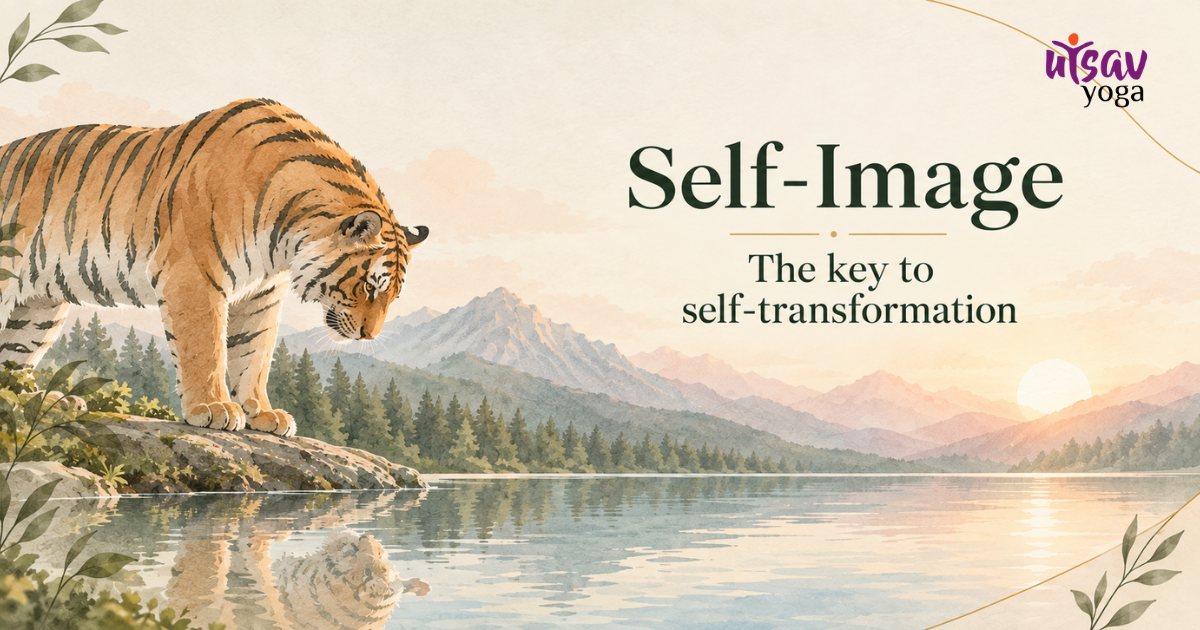
Let me begin with an old story.
A tiger cub was separated from its family and was found by a flock of sheep. It grew up among them. It ate what the sheep ate. It moved the way they moved. It made the sounds they made. Nobody had to convince it of anything; it simply took on the image it saw reflected all around it, and it lived its whole life accordingly.
One day, when it had grown, it came across a family of tigers. They recognised their own. They pulled him aside and tried to tell him: you are not a sheep, you are a tiger, you are one of us. He could not take it in.
So they took him to a lake and asked him to look at his own reflection.
The moment he saw the distance between what he had believed himself to be and what he actually was, he roared.
Nothing about the tiger had changed that day. His strength was always there, unused. What changed was the image.
And that is the whole point: what we see of ourselves influences how we behave, and the qualities we manifest are deeply connected to the self-image we carry.
Where Most of Us Begin
Most of us begin our journey of self-discovery with a very static version of ourselves—a version that is full of flaws and failures, lacking in character or ability. A version where, whatever we attempt, we somehow end up failing.
When we carry such a negative self-image, it is very likely that the transformational programme or spiritual path we take up will struggle to create lasting change.
Not necessarily because the method is wrong, but because for any transformation to happen, there has to be a certain fluidity in the way we hold our own self-image.
We also need to understand that we have immense potential. Anything that we set as a meaningful and rightful goal, we have the ability to move towards—perhaps only by an inch at first, but the ability is there.
So, the starting point of any self-transformation work is creating flexibility in the mind, where we are no longer bound by a rigid picture of who we are.
The self-image has to change.
We have to begin thinking of ourselves in a more positive and adaptable way: that we are open to learning, open to change, capable of growth, and willing to discover possibilities within ourselves that we may not have recognised before.
If we can make that transition from a rigid, negative self-image to a positive and dynamic one, our ability to work towards the things we set for ourselves can change significantly.
The Verdicts We Keep Repeating
Often, a negative self-image is not simply a vague feeling. It takes the form of a permanent judgement we have given ourselves about our appearance, our abilities, our character or the way we relate to the world.
Some people believe that they are unattractive. Some believe that they do not have a strong character. Others believe that they are incapable, unsuccessful or simply not good enough.
These are not always passing thoughts.
They can become verdicts—repeated so many times that we eventually stop questioning them.
And a belief held that rigidly can become a significant barrier to change. Not necessarily because it is true, but because we have stopped treating it as something that can change.
The moment we begin to question these conclusions, we create space for another possibility.
Perhaps I can learn.
Perhaps I can change.
Perhaps I can become something I have never imagined myself to be.
That possibility is where transformation begins.
When Belief Shapes Our Experience
Our expectations, beliefs and emotional states can influence the way we experience our bodies and respond to different situations.
Two people can encounter similar circumstances and experience them very differently because of the beliefs and expectations they bring with them.
This is one reason why our inner world deserves attention when we speak about transformation.
What we believe about ourselves influences how we approach challenges, how we respond to failure, how we relate to others and how willing we are to attempt something new.
Older traditions have long emphasised the relationship between the inner and outer dimensions of life. Modern research continues to explore how expectations, perception and psychological states interact with physical experience.
The important insight is not that our thoughts can magically control everything that happens to us.
Rather, it is that the way we understand ourselves can profoundly influence the way we live.
What we believe about ourselves, and what we repeatedly feel about ourselves, can shape our behaviour, our relationships and the possibilities we are willing to pursue.
We Usually Start From the Outside
What happens instead is that we often begin with external steps.
We start following a process, a discipline or a routine without changing the internal paradigm through which we see ourselves.
We may change our habits, our appearance, our work or our daily routine, but continue to carry the same internal image.
Yet lasting transformation requires us to look deeper.
Our external world is often influenced by our inner world. If we want to create meaningful external change, we also need to examine what is happening within.
The self-image has to shift.
Our work, our appearance, the way we speak and the way we relate to others can all be influenced by the way we perceive ourselves.
This does not mean that everything outside us is simply a reflection of our thoughts. Life is far more complex than that.
But it does mean that the image we hold of ourselves can influence the way we engage with the world.
What Yoga Points To
To me, this is one of the fundamental understandings of yoga: that there is immense potential within us and that we are not as limited as the identities we often create for ourselves.
The only thing required to begin is a belief—or perhaps an understanding. And I know that "belief" is a word that can be debated.
But once we actually begin the process of yoga, it can move beyond belief.
A realization can begin to emerge:
I am not merely this body and mind. I am that which is aware of this body and mind.
This shift in identification is fundamental.
As long as our identity is completely tied to the body, the mind and the beliefs we have accumulated, our sense of possibility can remain limited by them.
But when we begin to recognise the awareness behind our thoughts, emotions and experiences, we create a different relationship with ourselves.
We begin to see that a thought is something we experience—not necessarily something we have to become.
A belief is something we carry—not necessarily something we have to remain bound by.
An identity is something we can examine—not necessarily something that must remain fixed forever.
And once we begin living with this sense of inner fluidity, we create greater space for change.
We can alter the way we see ourselves.
We can alter the self-image we have been carrying.
And as the self-image changes, the way we engage with our physical, emotional and external lives can begin to change as well.
Transformation Begins With How We See Ourselves
Self-transformation, then, begins not simply with changing what we do, but with examining who we believe ourselves to be.
The tiger did not become a tiger when he looked into the lake.
He discovered what had always been there.
In the same way, our journey may not always be about creating something completely new. Sometimes, it is about removing the rigid images and limitations that have prevented us from recognising our own possibilities.
When our self-image becomes more fluid, our possibilities become more expansive.
And when we begin to see ourselves differently, we create the space to live differently.
Perhaps the first step towards transformation is not asking, "How do I change myself?" but asking, "Who have I believed myself to be?"
The answer to that question can become the beginning of a very different journey.