



Ganesh Chaturthi: From Form to Formless | A Yogic Perspective
15th Sep 2026 | Author - Viraj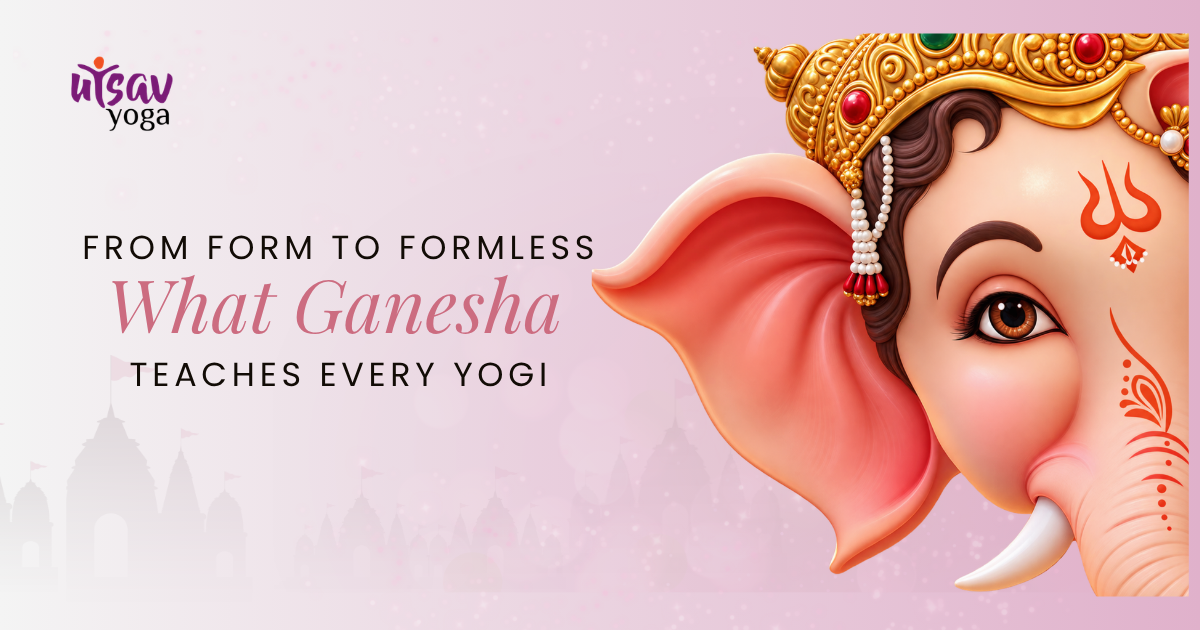
Ganesh Chaturthi is one of the most deeply cherished and auspicious festivals celebrated by millions of Indians, both in India and across the world. Traditionally observed during the latter part of the monsoon, the festival marks the birth of Ganesha, the beloved son of Shiva and Parvati.
For many, Ganesh Chaturthi is a celebration filled with devotion, rituals, music, community, and joy. But beyond the mythology and festivities lies a profound yogic insight—one that speaks about form, devotion, surrender, ego and ultimately, freedom.
The Story of Ganesha's Birth
According to Hindu mythology, Ganesha was born to Parvati as a young boy. One day, while Parvati was bathing, she asked Ganesha to guard the entrance and not allow anyone to enter.
When Shiva arrived, Ganesha did not recognize him and stopped him from entering.
A confrontation followed, and in his anger, Shiva cut off Ganesha's head.
When Parvati emerged and saw what had happened, she was devastated. As a mother, she demanded that her son be brought back to life.
Shiva then instructed his attendants to bring the head of the first living being they encountered. They returned with the head of an elephant.
Shiva placed the elephant's head onto Ganesha's body, and Ganesha was brought back to life.
This is the familiar mythological story of the birth of Ganesha. But Ganesh Chaturthi can also be understood through another lens—the yogic perspective.
The Deity We Create, Worship, and Eventually Release
Every year, we create a form of Ganesha.
We give that form our love. We worship it. We offer prayers, devotion, and reverence to it. We develop a relationship with the Divine through that form.
And then comes Visarjan.
The very form that we created and worshipped with so much love is eventually immersed in flowing water and allowed to dissolve.
At first glance, this may seem like the end of the celebration.
But from a yogic perspective, it carries a much deeper meaning.
We create the form.
We establish a relationship with the Divine through the form.
We pour our devotion into the form.
And finally, we learn to let go of the form.
The form disappears. The formless does not.
The idol may dissolve, but the devotion does not disappear.
The relationship with the Divine does not disappear.
What remains is something deeper than the physical form.
The formless can emerge through the form.
This is one of the most beautiful insights that Ganesh Chaturthi offers us.
Why Do We Need a Form to Experience the Divine?
For most people, relating to something completely formless is not easy.
The human mind naturally looks for something it can see, understand, relate to, and love.
This idea is also reflected in the Bhagavad Gita, where Arjuna asks Krishna about devotion to the formless versus devotion to a manifested form of the Divine.
Krishna explains that for an embodied human being, devotion to the unmanifest and formless can be difficult.
Beginning with a form can therefore become a natural and accessible entry point into the path of Bhakti.
The form gives the mind something to focus on.
Something to love.
Something to surrender to.
And Ganesha becomes a beautiful representation through which that relationship with the Divine can begin.
The Deeper Lesson: Learning to Let Go of Form
But there is another lesson here—perhaps one of the most important lessons for a yogi.
Eventually, we have to learn to loosen our attachment to all forms.
Not only the form of the deity.
But also our own form.
We become attached to our:
Body
Appearance
Stature
Achievements
Social image
Identity
Opinions
Roles
Ego
We begin to believe:
“This is who I am.”
But the yogic journey invites us to look beyond these changing forms.
Our body changes.
Our circumstances change.
Our identities change.
Our achievements come and go.
Even the image we have of ourselves continues to evolve.
The form is temporary.
And learning to recognize this is an essential part of inner freedom.
Celebrate the Form, But Don't Become Attached to It
The yogic teaching is not that we should reject form.
Quite the opposite.
We can celebrate the form.
We can love the form.
We can worship the form.
We can experience devotion through the form.
But we must also learn to let go of our attachment to the form.
This distinction is important.
The problem is not having a body, an identity, a role, or an achievement.
The problem begins when we become completely identified with them.
Ganesh Chaturthi reminds us that we can love something deeply and still have the wisdom to let it go.
Just as the Ganesha idol eventually returns to the elements, everything in the material world is subject to change.
Why Do We Invoke Ganesha Before Auspicious Beginnings?
There is a reason Ganesha is traditionally invoked before beginning something important.
Whether it is a marriage, a new venture, a new project, or another significant chapter of life, Ganesha Puja is often performed at the beginning.
Ganesha is traditionally associated with the removal of obstacles and auspicious beginnings.
But from a yogic perspective, perhaps the deeper significance lies in the state of mind with which we begin.
A ritual of invocation gives us an opportunity to pause.
To become present.
To establish an intention.
To put aside our personal expectations.
And to acknowledge that we are not entirely in control of the outcome.
That shift in perspective can change the way we approach the action itself.
Beginning Without Ego: The Wisdom of Karma Yoga
This connects beautifully with the yogic principle of Karma Yoga.
In Karma Yoga, action is not abandoned. We continue to act, work, and make a sincere effort.
But we begin to loosen our attachment to the idea:
“I am the doer.”
Instead of placing the entire emphasis on personal achievement and ownership, we begin to see ourselves as an instrument of the Divine.
We act.
We make the effort.
We take responsibility for our actions.
But we gradually release the ego associated with doership and the expectation of a particular outcome.
Perhaps this is one of the deeper intentions behind invoking Ganesha before beginning something significant:
Let me begin without ego.
Let me begin with the right intention.
Let me be present.
Let me become an instrument.
And when an action begins from that state, it naturally carries a different quality.
From Form to Formless
Perhaps this is why Ganesh Chaturthi holds such deep significance for a yogi.
The festival gives us a living reminder of a profound inner journey:
From form to formless.
From ego to surrender.
From attachment to freedom.
We create the form.
We worship the form.
We love the form.
We pour our devotion into the form.
And then, we let the form go.
But what remains?
The devotion.
And ultimately:
The Divine.
What Ganesh Chaturthi Can Teach Every Yogi
Ganesh Chaturthi invites us to reflect on some deeply personal questions:
Can I love without becoming attached?
Can I act without being consumed by the ego of doership?
Can I celebrate my identity without believing that it completely defines me?
Can I surrender what I cannot control?
Can I see the changing forms of life while remaining connected to what is unchanging within?
These are not merely philosophical questions.
They are part of the yogic journey.
The practice of yoga is ultimately not only about the body. It is about understanding the mind, loosening our attachments, and moving towards greater freedom.
And Ganesh Chaturthi gives us a beautiful reminder of this journey.
The Form Is Temporary. The Divine Remains.
The Ganesha idol is created.
It is loved.
It is worshipped.
And eventually, it dissolves into water.
Yet the devotion remains.
The Divine remains.
The experience remains within us.
Perhaps that is the deepest message of Ganesh Chaturthi:
We can love the form, celebrate the form, and worship the form—while remembering that the form is not the final destination.
The journey is from the form to the formless.
From identification to awareness.
From ego to surrender.
From attachment to freedom.
May Ganesha remove not only the obstacles outside us, but also the obstacles within us.
May we learn to loosen our attachment to form, ego, and the sense of doership.
And may we discover the formless presence that was always there.
Happy Ganesh Chaturthi.